
Freight invoicing
Freight invoicing that starts from the job’s own costs
Margin on a job is usually a number reconstructed at month-end from three sources that disagree. In CargoSharks, costs land against the job as they happen, supplier bills are matched to them before anyone approves, and the invoice is raised from the same ledger.
Open the live demoAsk for a pilotWhat the product doesHow we compare
01 · Costing
Margin that is live, not annual
- Every line against the job. Costs and revenue are recorded against the job, including the charge lines the free-time clocks write themselves.
- Unbilled revenue. What has been earned and not yet invoiced, by shipment, with one act to draft the invoice for it.
02 · Supplier bills
The argument with the agent, before the customer is invoiced
- Read into lines. An uploaded scan, or a bill emailed in by a partner you already know, is read into lines and matched against what the job accrued.
- Variance on screen. The difference is a number on screen before anyone approves, and a line billed over the accrual tolerance raises an alert on its own.
- Agents netted. Agent accounts are netted period by period into one balance, rather than a receivable and a payable that never meet.
03 · Invoicing
Separated duties, per entity and currency
Invoices are raised per entity in the entity’s own currency, with tax treatment and rate per line, and move through draft, approved, issued, part-paid, paid and credited. Only Finance may issue, void or raise a credit note: an operations manager who can issue invoices is the segregation-of-duties failure an auditor asks about first.
04 · Receivables
What you are owed, and who to ring
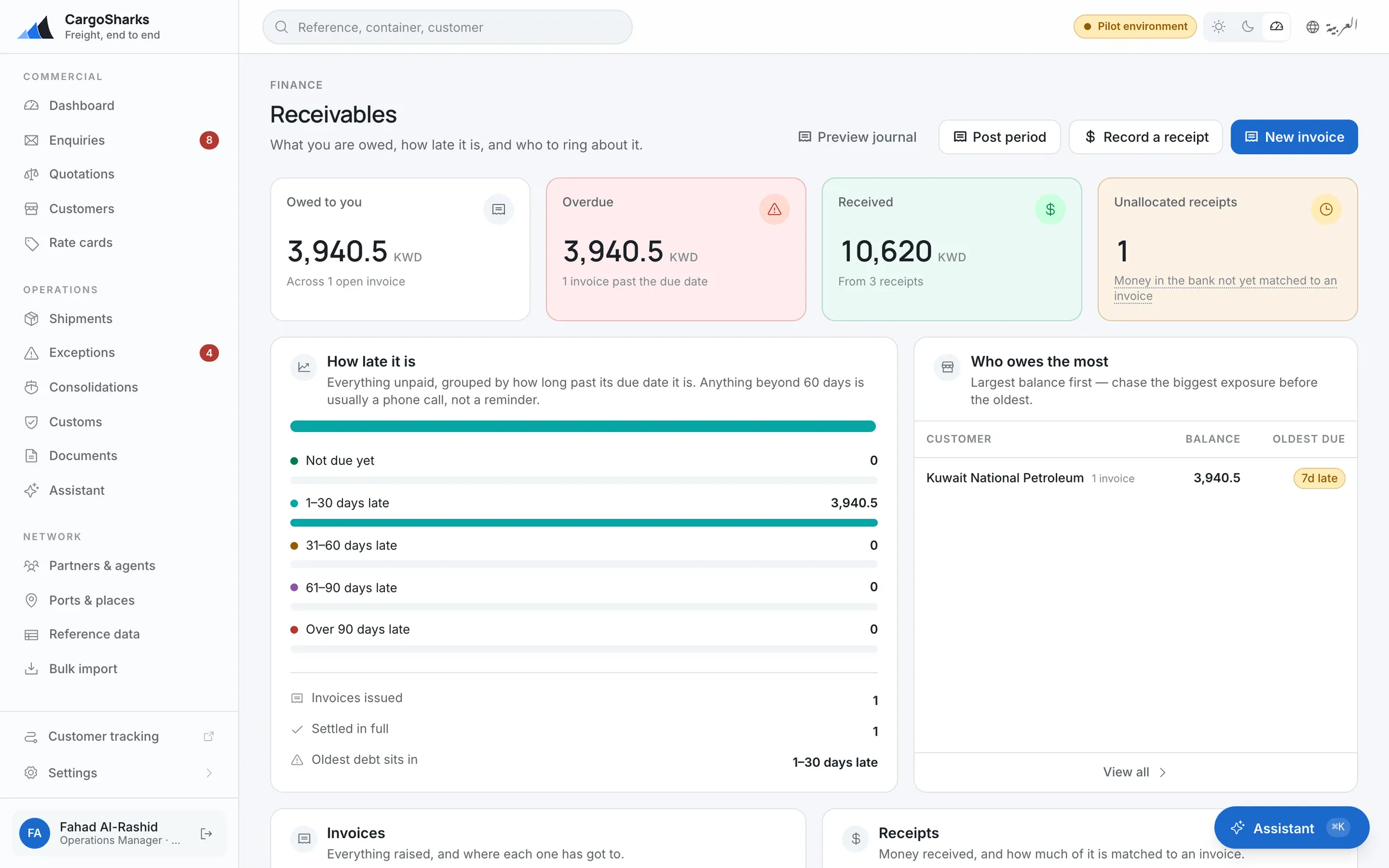
Receivables grouped by age with the largest exposure first, receipts matched to invoices with a warning for unmatched money, and each customer’s standing checked against their credit limit when a shipment is booked. An override, when you give one, is recorded with who gave it and why. Customers see their own invoices and balance in the portal.
On the screen
The screen, from the running demo
Seven seeded roles, six keys an auditor asks about
| Role | Issue an invoice | Credit one | Approve a supplier bill | Split a master cost | Book a job | Close one |
|---|---|---|---|---|---|---|
| Administrator | granted | granted | granted | granted | granted | granted |
| Finance | granted | granted | granted | granted | not granted | not granted |
| Operations Manager | not granted | not granted | not granted | granted | granted | granted |
| Coordinator | not granted | not granted | not granted | not granted | granted | not granted |
| Sales | not granted | not granted | not granted | not granted | not granted | not granted |
| Customs Broker | not granted | not granted | not granted | not granted | not granted | not granted |
| Read Only | not granted | not granted | not granted | not granted | not granted | not granted |
The boundary
What it does not do
Two gaps a finance team asks about early.
- E-invoicing transmissionNot shipped for the UAE or Saudi Arabia. Invoices carry tax treatment and rate per line, and the hand-off to an accredited provider is built but not switched on. Generating the mandated document is on the roadmap with no ship date.
- Accounting connectorsNo direct connector to a specific accounting package in this release. A journal of the period’s invoices, receipts, supplier bills and payments exports in a form your accountant can import.
Can we keep our accounting package?
Yes. A journal of the period’s invoices, receipts, supplier bills and payments exports in a form your accountant can import. Posting it marks what it took, so nothing is exported twice.
How are supplier bills matched?
The bill is read into lines and each line is compared with what the job accrued. The variance is shown before approval, and over-billing beyond the tolerance raises an alert.
Does it handle the Kuwaiti dinar properly?
Yes. Money is decimal throughout and rounds per currency at the line, so KWD keeps three decimal places on every invoice.
Can it issue UAE or Saudi e-invoices?
Not yet. Invoices carry tax treatment and rate per line, but the mandated e-invoice formats and their transmission are on the roadmap with no ship date.
Who can issue an invoice?
Only the Finance role can issue, void or credit. Operations can see the job’s costs and margin but cannot issue.
Read next
Related pages
The fastest way to judge this is to open it.
The demo is the real software on seeded data, with sign-ins for you, your customer and your agent. Nothing you do in it touches anything.